Post Google I/O I installed AGY, Then I Opened the Repo...

Summary
At the recent, long-awaited Google I/O event, Google announced it is replacing its popular open‑source AI command‑line tool, Gemini CLI, with a new product called AGY (part of the “Antigravity” suite). On paper, AGY is impressive: it’s faster, better engineered, and unifies Google’s AI capabilities across desktop, CLI, SDK, and IDE so the same engine powers every interface. From a pure technology and architecture standpoint, it’s a clear upgrade.
Google is well placed as owning the entire AI stack from hardware, datacenters to application layer. But the AI tooling is still maturing and consolidating - so we need to wait and watch. Remember, great engineering without long‑term platform stability is just a polished demo, not a safe foundation.
Late to the party
Last week, Google held its big I/O event for 2026. As usual, there was a lot of noise and a tangle of new technologies, but I was genuinely excited about AGY (Antigravity CLI). I installed it as soon as I could after reading the announcement. My first query was lightning fast. The Go rewrite is real, and there’s none of the Node.js lag. I’ve been interested in Rust lately, so I appreciate the performance gains you get from statically typed compiled languages. Still, something felt off.
So I checked out the repository, and then it hit me.
104,000 GitHub stars. 13,800 forks. 6,000+ merged pull requests. All Apache 2.0. That was Gemini CLI — the open-source CLI Google is killing on June 18.
The AGY repo only has a README, a CHANGELOG, and a GIF. There’s no source code.
That’s the part no one is talking about, along with how much it resembles OpenAI Codex.
The gamble
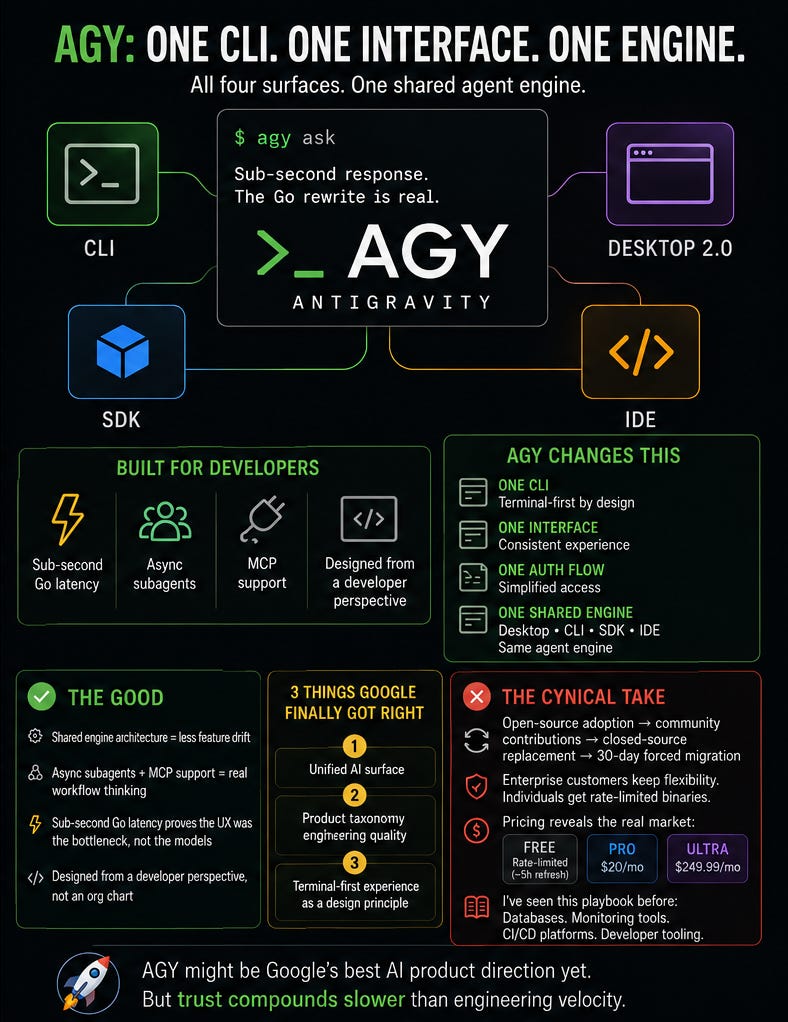
Announced at I/O on May 19, AGY is Google’s new command-line tool for AI. It’s part of their “Antigravity” suite, which includes four interfaces: Desktop 2.0, CLI, SDK, and IDE. All of them use the same agent harness. One engine powers four interfaces, so there’s no feature gap between the terminal and the GUI. That’s solid architecture.
AGY is built in Go instead of Node.js, and you can tell. Complex prompts run smoothly, without the stutter you get from Node-based CLIs when the event loop slows down. Gemini 3.5 Flash says it can process 289 tokens per second. My own informal testing backs that up—it’s fast, but the latest model might get pricey since I ran out of tokens pretty quickly.
The shared harness is the best part of this announcement. After years of building platform engineering teams, I know that keeping features consistent across different interfaces is always tough. If the desktop app can do something the CLI can’t, or vice versa, developers start to lose trust in the platform. Google fixed that by using one engine for everything. The CLI isn’t just an extra—it’s a main feature. Async subagents, MCP server support, SSH-aware authentication—clearly, someone on the team actually uses the terminal for real work.
But here’s the problem with good engineering and poor strategy: it doesn’t matter if people don’t trust you to keep the product going.
Another incarnation...
Check out the HN thread on AGY (news.ycombinator.com, May 19). The top comment says, “I don’t ever say ‘Antigravity’, because it’s not worth getting invested in a tool that will be dead in two years.” Every developer knows what that means. Years of Google product churn have taught us to spot the pattern.
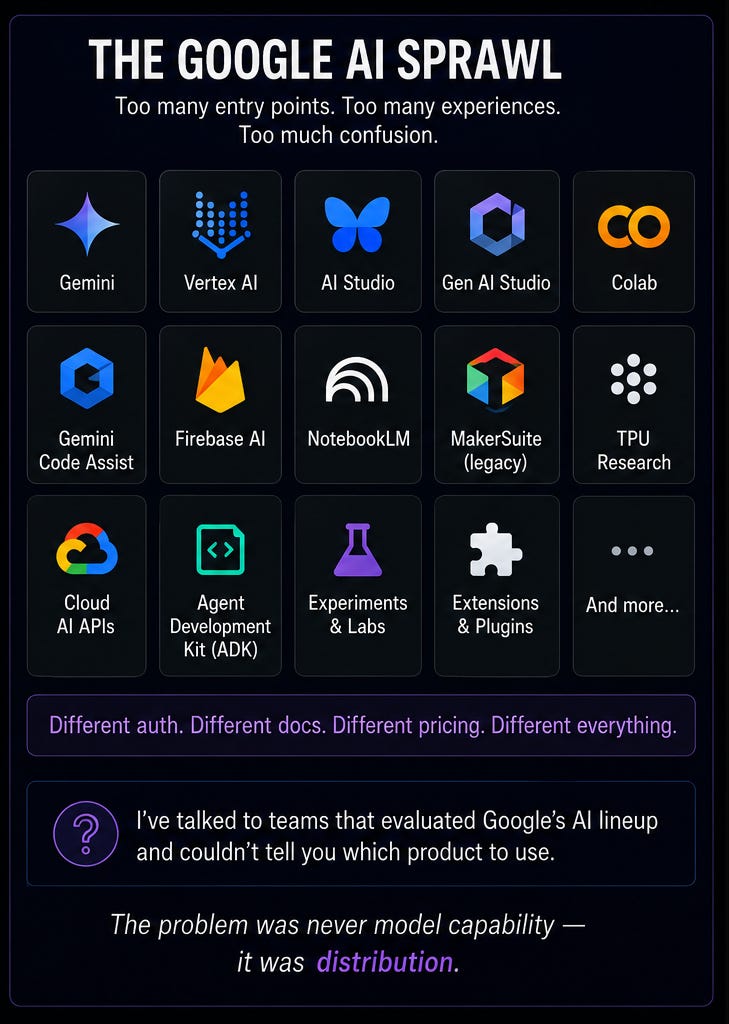
Bard became Gemini. MakerSuite became Gen AI Studio, which became AI Studio. Gemini CLI is becoming AGY. Each rebrand, each forced migration, each shut-down API burns a bit of whatever goodwill developers still have. I’d written Google off entirely for AI development because they couldn’t figure out which product to use from day to day. The product taxonomy quiz was exhausting.
Gemini CLI was open source under the Apache 2.0 license. The community sent in 6,000 pull requests. Companies built their workflows around it. Google accepted those contributions, merged them, and benefited from them, then replaced everything with a closed-source binary and gave everyone just 30 days to migrate.
Here’s the detail that says it all about their strategy: enterprise customers can keep using Gemini CLI. Only individual developers have to migrate. There are two levels of developer access. One group gets to keep things as they are. The other gets a closed-source binary with a free tier that, according to several users, runs out of requests quickly. The Register reported on the backlash on May 20.
Enterprise customers get to test new features. Individual developers end up doing free work.
..or part of a bigger story
The pricing reinforces the message. Free (rate-limited, quota refreshes every ~5 hours). Pro at $20/month. Ultra at $249.99/month. That Ultra tier isn’t priced for individuals — it’s an enterprise SKU with a three-digit price tag. And those are the same customers who get to keep Gemini CLI access.
I’ve been both a platform vendor and a platform customer. I’ve seen this playbook before. It starts with open-source adoption—free, open, and community-driven. Build the ecosystem. Get people to contribute. Then release a proprietary replacement that’s better in every measurable way. Force everyone to migrate. Change the pricing. The community that helped you grow is now your source of revenue.
Databases did this, Monitoring followed, and so did CI/CD platforms. Now, AI tooling is doing it.
The difference this time is the timeline. 30 days to migrate from an open-source CLI you may have integrated into your workflow. Thirty days. And then the old one stops working.
A cautious but welcome change
I’ll keep testing AGY. It’s fast, the shared harness is well-architected, and async subagents are the right direction. But I’m not building dependencies on it. No tight integrations. No workflow automations that would be painful to unwind. I’ve been burned by platform abandonment enough times to know the pattern.
The tough lesson for Google, and for any platform vendor reading this, is that trust builds up much more slowly than technical debt. You can rewrite a CLI in three months, but it takes years to rebuild developer trust.
AGY is well built. The Antigravity team should be proud of their work on the architecture.
But great engineering without platform stability is just a fast demo.
Have you started migrating yet? Did your AGY experience match mine—fast CLI, but a cold feeling about the strategy? Let me know what you think.
References
Google I/O 2026 — AGY and Antigravity announcement, May 19, 2026
Gemini CLI GitHub repository (archived) — 104k stars, Apache 2.0 license
AGY GitHub repository — README + CHANGELOG + GIF, no source code
Hacker News discussion — developer sentiment thread on AGY announcement
The Register — “Google’s closed-source AI CLI replacement draws developer ire.”